
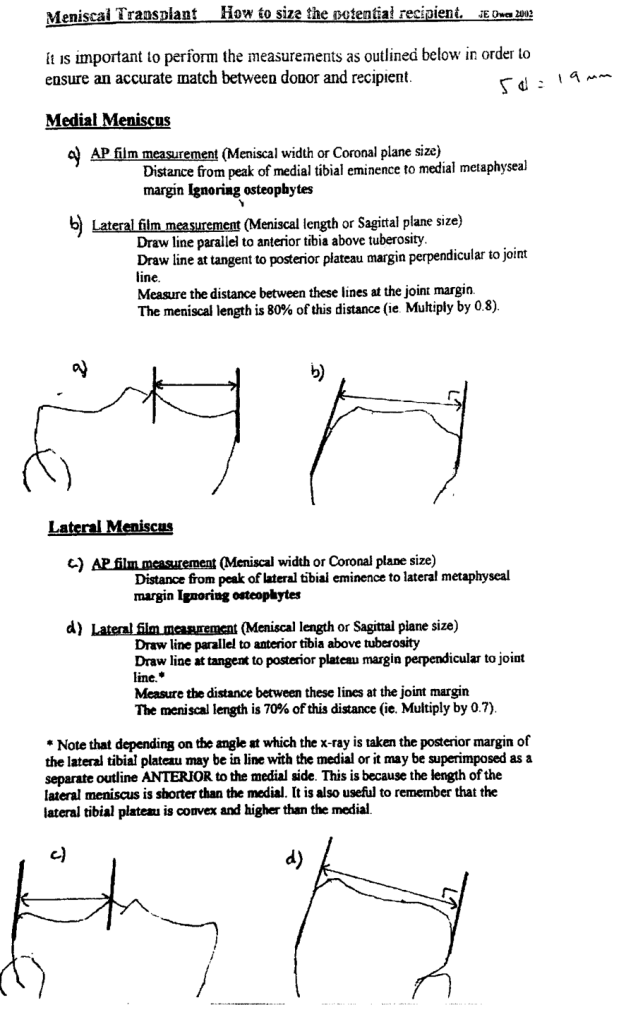
Numerous methods have been described to size the recipient knee for meniscal allograft transplant (MAT). The most widely used method was described by Pollard et al and uses plain AP and lateral radiographs [1].
Pollard’s method
Request AP and lateral radiographs with a marker of known diameter (e.g. 5 pence or diameter coin) taped to the specific recipent side of the knee (medial or lateral) in order to correct for magnification.
MAT sizing excel This excel spreadsheet can be used to help with MAT sizing using Pollard’s method.
MAT success depends on accurate sizing to match the donor and recipient’s knee. If the graft is too big, the graft will distribute the load of the femoral condyle on the tibia. If the graft is too small, forces on the meniscal will be increased, leading to graft failure. Meniscal Allograft Transplantation: A Comprehensive Review contains a chapter dedicated to different techniques for sizing meniscal allografts [2].
NB: The nomenclature for describing meniscal size can be confusing. By convention, meniscal width
describes the medial-lateral, coronal plane dimension, which is determined from the AP radiograph. Meniscal length refers to the AP, sagittal plane meniscal dimension and is determined from the lateral radiograph.
1. Pollard ME, Kang Q, Berg EE (1995) Radiographic sizing for meniscal transplantation. Arthroscopy 11:684–687. https://doi.org/10.1016/0749-8063(95)90110-8
2. Kaleka C, Cohen M (2015) Methods for the pre-operative sizing of meniscal allografts. In: Getgood A, Spalding T, Cole BJ, et al (eds) Meniscal allograft transplantation : a comprehensive review, 1st ed. DJO Publications, London, p 360
 bonesbonesbones